
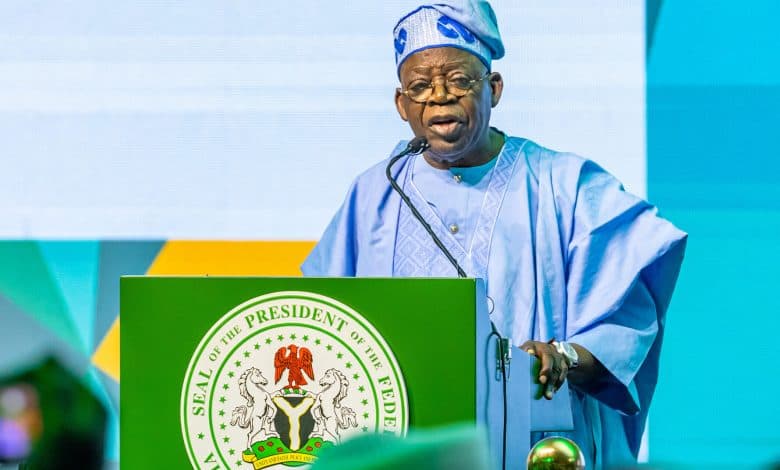
President Bola Tinubu has commended the Economic and Financial Crimes Commission for recovering ₦1.23 trillion in assets and recording 10,872 convictions over a 34-month period, as the government pushes for stronger action against financial crimes. The President’s commendation was delivered by Vice-President Kashim Shettima at the opening of the eighth EFCC and National Judicial Institute […]
President Bola Tinubu has commended the Economic and Financial Crimes Commission for recovering ₦1.23 trillion in assets and recording 10,872 convictions over a 34-month period, as the government pushes for stronger action against financial crimes.
The President’s commendation was delivered by Vice-President Kashim Shettima at the opening of the eighth EFCC and National Judicial Institute workshop for judges and justices in Abuja on Tuesday. The three-day programme is focused on investigating and prosecuting economic and financial crimes in an increasingly digital environment.
Tinubu described the commission’s work on financial crime investigations, asset recovery and cryptocurrency-related offences as encouraging. He said the agency’s efforts to recover virtual assets showed the importance of adapting law enforcement to changing methods of committing financial crimes.
He also pointed to the prosecution and deportation of 192 foreign nationals arrested in connection with cyberterrorism and cryptocurrency fraud. According to the President, tackling these offences requires investigators and judicial officers to understand evolving technologies and the sophisticated techniques used to conceal illegal financial activities.
Data provided by the EFCC showed that it received 49,673 petitions and investigated 39,615 cases from October 1, 2023, to July 31, 2026. The commission said the investigations produced 14,476 court filings and 10,872 convictions, giving it a reported conviction-to-filing ratio of 75.1 per cent.
Its reported recoveries during the period included ₦1.233 trillion, $684.48 million, £373,905.78 and €9.34 million. Tinubu said money recovered from financial crimes had also supported government social intervention initiatives, including NELFUND, which provides education loans, and CREDICORP, the Nigerian Consumer Credit Corporation.
The President urged the EFCC and judicial officers to address procedural weaknesses and improve the handling of corruption cases. He warned that cases could be undermined by technical issues and said anti-corruption efforts should involve the executive, legislature and judiciary rather than rest on one arm of government alone.
EFCC Chairman Ola Olukoyede said the commission was improving intelligence gathering, forensic investigations and cooperation across jurisdictions. He maintained that its priority was to build stronger cases capable of meeting the required standard of proof, while ensuring that recovered assets were obtained and managed lawfully and transparently.
Chief Justice of Nigeria Kudirat Kekere-Ekun stressed that efforts to prosecute financial crimes must respect constitutional safeguards. She said digital records, cryptocurrency transactions, encrypted communications and cross-border financial activities had complicated criminal proceedings, requiring judges to understand how electronic evidence is collected, preserved and authenticated. She maintained that every defendant was entitled to fair hearing and that prosecutors must prove allegations with credible, admissible evidence.