
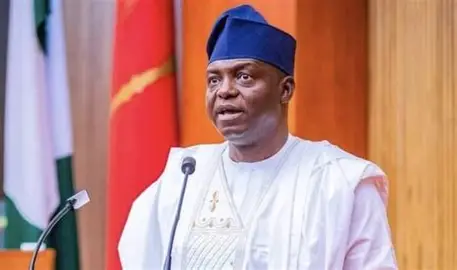
The All Progressives Congress (APC) has expressed confidence in its chances ahead of the 2027 general elections, boasting that its 13 million registered members, 31 governors and extensive political structures give it an advantage over opposition parties. The party’s National Chairman, Professor Nentawe Yilwatda, made the declaration on Saturday when he received an Economic Community […]
The All Progressives Congress (APC) has expressed confidence in its chances ahead of the 2027 general elections, boasting that its 13 million registered members, 31 governors and extensive political structures give it an advantage over opposition parties.
The party’s National Chairman, Professor Nentawe Yilwatda, made the declaration on Saturday when he received an Economic Community of West African States (ECOWAS) pre-election fact-finding mission at the APC national secretariat in Abuja.
The delegation was led by former Sierra Leone Vice-President, Victor Bockarie Foh, who said the mission was in Nigeria to assess the political environment and support preparations for credible elections.
Speaking during the meeting, Yilwatda described the APC as the country’s largest political party, claiming that its membership and organisational strength were approximately three times greater than those of its closest rival.
He disclosed that the party had about 13 million registered members spread across local government areas nationwide, with membership records containing identification details linked to National Identification Numbers and voter identification information.
The APC chairman also revealed that the party had more than 261,000 executive members operating across its ward, local government, state and national structures, describing the network as a major strength for grassroots mobilisation and election planning.
Giving details of the party’s political representation, Yilwatda said the APC controlled 31 of the 36 governorship seats, had 88 senators out of 109 and occupied 208 seats in the 360-member House of Representatives.
He added that the party also had a strong presence in state legislatures and maintained support networks involving women, youths and persons with disabilities.
Yilwatda further disclosed that the APC had inaugurated its campaign council, begun election preparations and uploaded its candidates to INEC’s portal, expressing confidence in the party’s readiness for the polls.
He nevertheless urged the electoral commission to adhere strictly to its published timetable, insisting that all political parties must be treated equally to guarantee a transparent and credible electoral process.
The APC chairman also said the party’s confidence was built on its organisational strength and preparedness rather than an assumption that it would automatically win the election.
In another development, Yilwatda identified the infrastructure projects of President Bola Tinubu’s administration as a major advantage for the APC ahead of the 2027 elections, describing them as an “unbeatable campaign asset”.
He spoke while inspecting ongoing construction work on the Akwanga, Jos and Gombe sections of the Trans-Sahara Superhighway, saying Nigerians would judge the administration by the projects delivered across the country.
According to him, the Akwanga-Jos road corridor had suffered decades of inadequate attention, with communities along the Nasarawa-Plateau axis experiencing mainly piecemeal repairs since the early 1970s.
He said the present administration had committed hundreds of billions of naira to the reconstruction, noting that the adoption of rigid concrete pavement technology would provide a more durable road network for the region.
Yilwatda maintained that the projects demonstrated the impact of Tinubu’s Renewed Hope agenda and would encourage Nigerians to continue supporting the President and the ruling party.
Meanwhile, Foh said the ECOWAS mission was consulting political stakeholders and gathering verified information to assess Nigeria’s preparedness for the 2027 elections.
He explained that the delegation would rely on systematic observations, credible data and evidence in developing its findings and recommendations on the country’s electoral environment. INEC has scheduled January 16, 2027, for the presidential election