
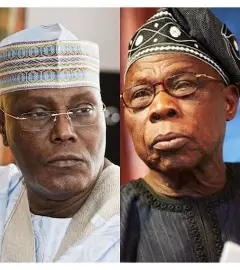
Former Vice President Atiku Abubakar has launched a fresh attack on former President Olusegun Obasanjo, accusing him of sustaining a campaign of political manipulation, deceit and damaging allegations against him for more than two decades. Atiku’s Media Adviser, Paul Ibe, made the accusation on Sunday in response to Obasanjo’s recent claim that Atiku mobilised the […]
Former Vice President Atiku Abubakar has launched a fresh attack on former President Olusegun Obasanjo, accusing him of sustaining a campaign of political manipulation, deceit and damaging allegations against him for more than two decades.
Atiku’s Media Adviser, Paul Ibe, made the accusation on Sunday in response to Obasanjo’s recent claim that Atiku mobilised the late former Speaker of the House of Representatives, Ghali Na’Abba, in an alleged attempt to remove him from office during their time in government.
Ibe said the allegation, reportedly made by Obasanjo on July 23, was another example of what he described as a recurring effort to revive accusations against Atiku whenever an election season approaches. He questioned the decision to involve Na’Abba, who died in 2023 and could no longer respond to the claim, and described the allegation as baseless and malicious. The Atiku camp cited former lawmaker Abubakar Bwari, who served as Chief Whip during the 1999–2007 legislative sessions, as disputing Obasanjo’s version of events and saying Na’Abba never sought the former president’s removal.
The statement also revisited the events surrounding Obasanjo’s bid for a second term in 2003. Ibe cited former Abia governor Orji Uzor Kalu, who was a PDP governor at the time, as saying Atiku personally appealed to about 17 governors to support Obasanjo’s re-election. Kalu reportedly said Atiku knelt before the governors and told them he did not want to be disloyal to Obasanjo, despite political arrangements that could potentially have positioned him for the presidency.
According to Ibe, the account by Kalu directly challenged claims allegedly advanced by Obasanjo’s camp that the former president had been compelled to kneel before Atiku to obtain support for his second-term bid. Kalu was further quoted as saying Atiku had the backing required to pursue his own presidential ambition but rejected the opportunity because he believed Obasanjo had trusted him and that betraying him would have been wrong.
The Atiku camp also brought up the long-running controversy surrounding the Petroleum Technology Development Fund shortly before the 2007 presidential election. Obasanjo had ordered a Senate investigation into alleged financial impropriety involving the fund, while Atiku denied the allegations and presented himself for investigation. The former vice president argued at the time that the accusations were politically driven and connected to his opposition to Obasanjo’s attempt to secure a controversial third term.
Ibe subsequently relied on the autobiography of the late Awujale of Ijebuland, Oba Sikiru Adetona, to challenge aspects of the PTDF controversy. He cited the monarch’s account of events involving EFCC officials and Globacom Chairman Mike Adenuga, including the reported raid on Adenuga’s Lagos residence in July 2006 and his subsequent detention over matters allegedly linked to PTDF funds.
The statement disputed the suggestion that Adenuga used PTDF funds to obtain Globacom’s operating licence, with Ibe saying the businessman secured financing from BNP Paribas Bank for the transaction. He also highlighted Oba Adetona’s account of Adenuga’s later dealings with Obasanjo, including an alleged meeting at which the former president requested the businessman’s assistance with an administrative block at Bells University.
Ibe said Adenuga subsequently left Nigeria amid what he described as continuing EFCC harassment and returned after Obasanjo left office. He also cited the late monarch’s account that construction work at Bells University slowed during Adenuga’s absence before the institution later sought discussions with him over the project. According to Atiku’s camp, the account raised questions about the contrast between the public treatment of Adenuga and his alleged private relationship with Obasanjo.
The dispute reflects the bitter breakdown of a political partnership that began before the 1999 presidential election, when Obasanjo chose Atiku as his running mate. Their administration won a second term in 2003, but disagreements over succession, alleged corruption and Obasanjo’s third-term ambition eventually deepened the rift. Atiku later left the PDP and contested the 2007 presidential election under the Action Congress after the relationship between both men collapsed.
Atiku, who remains a prominent opposition politician and is now the African Democratic Congress presidential candidate for the 2027 election, has continued to reject allegations associated with his political history with Obasanjo. Ibe accused the former president of repeatedly attempting to undermine Atiku’s reputation and said the latest claims would not survive scrutiny. Obasanjo has not publicly responded to the allegations, while his media aide, Kehinde Akinyemi, simply said, “No comment,” when contacted.