
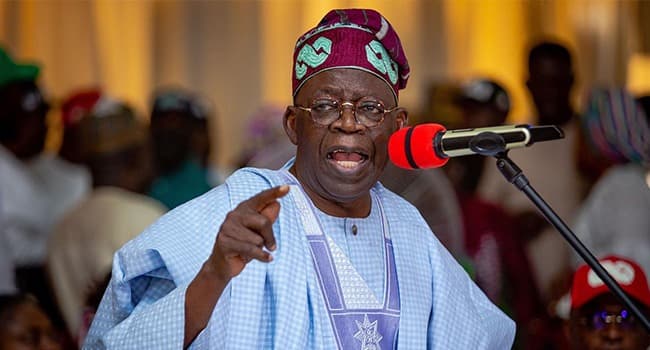
President Bola Tinubu has assured Nigerians that his administration’s economic reforms will soon produce more benefits at the household level, as Nigeria’s economy recorded 4.43 per cent growth in the second quarter of 2026. The President said the economy was now moving on an “irreversible path” towards stronger growth that Nigerians would increasingly experience in […]
President Bola Tinubu has assured Nigerians that his administration’s economic reforms will soon produce more benefits at the household level, as Nigeria’s economy recorded 4.43 per cent growth in the second quarter of 2026.
The President said the economy was now moving on an “irreversible path” towards stronger growth that Nigerians would increasingly experience in their homes and finances.
Tinubu spoke on Monday while responding to the latest GDP figures released by the National Bureau of Statistics, which showed that economic growth accelerated from 4.23 per cent in the second quarter of 2025 to 4.43 per cent in the same period of 2026.
According to the President, the figures were evidence that the difficult economic decisions taken since he assumed office were beginning to deliver the desired results.
He disclosed that the Federal Government would soon roll out additional interventions for vulnerable Nigerians, including cheaper transportation, increased food production and relief programmes targeted at communities across the country.
Tinubu said his administration had spent the last three years working to stabilise the economy and create the conditions for sustainable prosperity.
He pointed to stronger foreign reserves, improved trade figures, better credit ratings, infrastructure development and increased oil and gas production as indicators of progress under his government.
The President said Nigeria was now recording trade surpluses and claimed that foreign reserves had risen to their highest level in 17 years.
He also highlighted the construction of roads, railways and major highways, saying the projects were intended to support economic activity and provide infrastructure that would serve the country for years.
Tinubu further cited the education sector, noting that universities had remained free from strikes while NELFUND continued to expand access to student loans.
He said affordable credit was also being provided to civil servants through Creditcorp as part of efforts to improve access to finance.
The latest NBS figures showed that the expansion was broad-based, with agriculture, manufacturing, oil and gas and services all contributing to economic growth.
Agriculture grew by 4.39 per cent in the second quarter of 2026, compared with 2.82 per cent during the corresponding quarter of 2025.
The non-oil sector, which contributes roughly 96 per cent of Nigeria’s economy, recorded 4.31 per cent growth, compared with 3.64 per cent in the second quarter of last year.
The oil sector grew by 7.31 per cent in the quarter, while average daily crude oil production increased to 1.72 million barrels per day.
The latest crude production figure was the highest recorded since 2022 and exceeded the 1.68 million barrels per day recorded in the second quarter of 2025.
Nigeria’s nominal GDP also rose by 18.43 per cent, increasing from N100.73 trillion in the second quarter of 2025 to N119.29 trillion in the second quarter of 2026.
The services sector remained the largest contributor to the economy, accounting for 56.62 per cent of aggregate GDP during the period.
Economic analysts described the latest figures as encouraging, pointing to stronger performance in the services and non-oil sectors alongside improving oil production.
Despite the positive figures, Tinubu said the government’s priority was to ensure that economic growth eventually translates into tangible improvements in the lives of Nigerians.
He said the next phase of government interventions would therefore focus on vulnerable citizens through cheaper transportation, increased food production and targeted relief programmes.
The President also criticised opposition groups for allegedly attempting to minimise the achievements of his administration and promising to reverse some of its economic policies.
He maintained that the reforms were introduced to correct longstanding structural problems and establish the foundation for sustainable economic prosperity.
Tinubu said his administration would continue to consolidate the gains recorded so far while working to ensure that the benefits of economic growth are increasingly felt by ordinary Nigerians.