
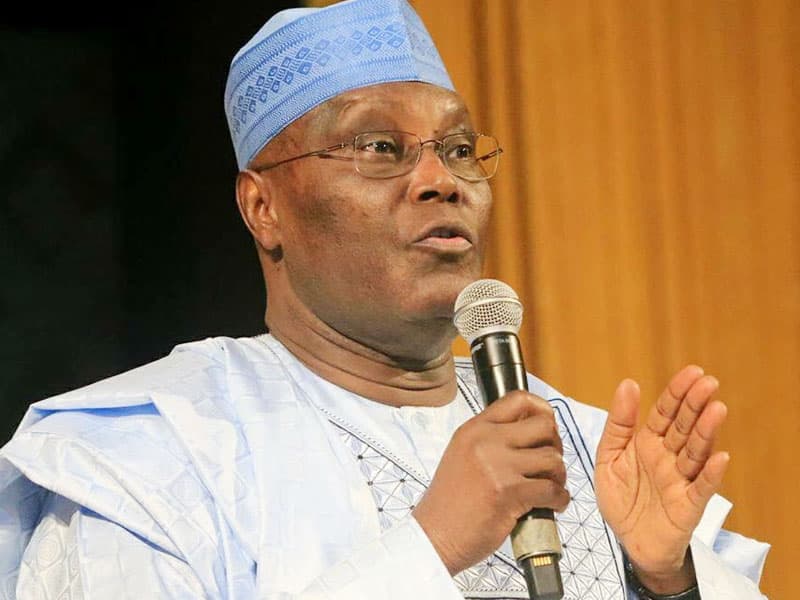
Former Vice President Atiku Abubakar has called on President Bola Tinubu to urgently increase the national minimum wage, saying rising petrol, food, transport and housing costs have eroded the purchasing power of Nigerian workers. Atiku, who is the presidential candidate of the African Democratic Congress, also expressed support for organised labour’s demand for a substantial […]
Former Vice President Atiku Abubakar has called on President Bola Tinubu to urgently increase the national minimum wage, saying rising petrol, food, transport and housing costs have eroded the purchasing power of Nigerian workers.
Atiku, who is the presidential candidate of the African Democratic Congress, also expressed support for organised labour’s demand for a substantial increase in workers’ salaries.
His position was contained in a statement issued by Phrank Shaibu, Director of Strategic Communications of the ADC Presidential Campaign Council.
Atiku argued that although the minimum wage was increased from ₦30,000 to ₦70,000, the change had not provided sufficient relief for workers because the prices of essential goods and services had also increased.
He used petrol prices to illustrate the decline in purchasing power, saying ₦30,000 could purchase about 118 litres of petrol when the national average stood at ₦254.06 per litre in April 2023.
According to him, the present ₦70,000 wage can purchase only about 50 litres when petrol is sold at ₦1,400 per litre.
Atiku argued that workers therefore have significantly less purchasing power in terms of fuel despite earning a higher nominal minimum wage.
He said the consequences extend beyond the cost of commuting, because petrol is also an important input in transportation, production and other economic activities.
The former Vice President said higher fuel costs eventually affect the prices of food, transportation and other goods purchased by Nigerian households.
He also compared Nigeria’s minimum wage with those of other African and oil-producing countries.
Atiku cited figures showing that Libya’s monthly minimum wage was equivalent to about ₦213,000, Algeria’s ₦245,000, Equatorial Guinea’s ₦302,000 and Gabon’s ₦351,000, based on exchange rates from July 24, 2026.
He added that the minimum wage in neighbouring Benin Republic also exceeded Nigeria’s when converted using the exchange rates referenced in his statement.
While acknowledging that countries have different wage structures and living costs, Atiku said the comparison illustrated the financial pressure facing Nigerian workers.
He maintained that the current wage does not adequately reflect the cost of sustaining a family under present economic conditions.
Atiku also criticised the removal of petrol subsidy, arguing that fuel prices rose without sufficient measures to protect working families from the resulting economic pressure.
He consequently called on the Federal Government to agree to a substantial wage increase that takes into account the current cost of food, transportation, rent and power.
The ADC candidate has also pledged to raise the minimum wage from the beginning of his administration if elected in 2027, making the issue part of his wider economic campaign message.