
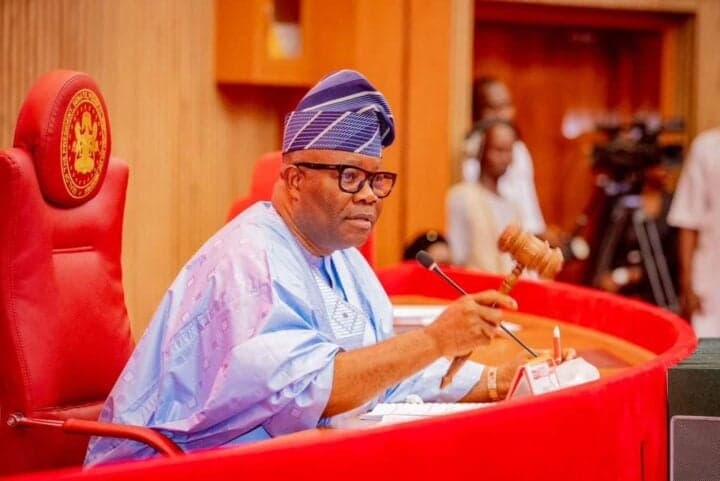
Senate President Godswill Akpabio has described the National Assembly as the bridge through which the hopes and aspirations of ordinary Nigerians should translate into government decisions. Akpabio made the statement on Tuesday while addressing the 153rd Assembly of the Inter-Parliamentary Union in Arusha, Tanzania, where he identified inclusion, trust and opportunity as essential pillars of […]
Senate President Godswill Akpabio has described the National Assembly as the bridge through which the hopes and aspirations of ordinary Nigerians should translate into government decisions.
Akpabio made the statement on Tuesday while addressing the 153rd Assembly of the Inter-Parliamentary Union in Arusha, Tanzania, where he identified inclusion, trust and opportunity as essential pillars of a democracy that delivers tangible benefits.
The Senate President, who chairs Nigeria’s National Assembly and leads the country’s delegation to the global parliamentary gathering, said the success of democracy should not be measured only by elections or economic statistics.
According to him, the true test of democratic governance is its impact on the daily lives of citizens, including whether people feel heard, included and confident about their future.
Akpabio said trust could not be imposed through legislation, arguing that public confidence must be earned through fairness, transparency, accountability and the fulfilment of promises.
“Every promise kept strengthens trust; every citizen heard brings government closer to the people,” he said.
He explained that the National Assembly exercises its responsibilities through legislation, representation, appropriation and oversight, creating a channel through which the concerns of Nigerians can influence government decisions.
“Parliament is a bridge over which the hopes of ordinary people travel into the decisions of government,” Akpabio said.
He also stressed the importance of inclusion, saying Nigeria’s different peoples, languages, cultures and faiths should be viewed as sources of strength rather than grounds for exclusion.
“Our many peoples, languages, cultures and faiths are sources of strength. No citizen should be a stranger in his own country, and no community should stand at the margins of our common future,” he said.
Turning to the Federal Government’s policies, Akpabio said the administration of President Bola Tinubu, working with the 10th National Assembly, was pursuing reforms intended to widen participation and expand opportunities for Nigerians.
He highlighted regional development institutions as part of efforts to bring development closer to communities and said tax reforms were aimed at making the system fairer, easing the burden on low-income earners and small businesses, and strengthening enterprise.
On education, the Senate President pointed to the Nigerian Education Loan Fund as an intervention designed to ensure that financial circumstances do not determine the future of young Nigerians.
He said eligible students could access interest-free financing for higher education, stressing that poverty should not determine the limits of a young person’s potential.
Akpabio urged parliamentarians to build institutions that listen to citizens, governments that serve them and systems that maintain public confidence.
He called for inclusion to be transformed into participation, trust into partnership and opportunity into shared prosperity, saying every community should have a stake in Nigeria’s national ambitions.