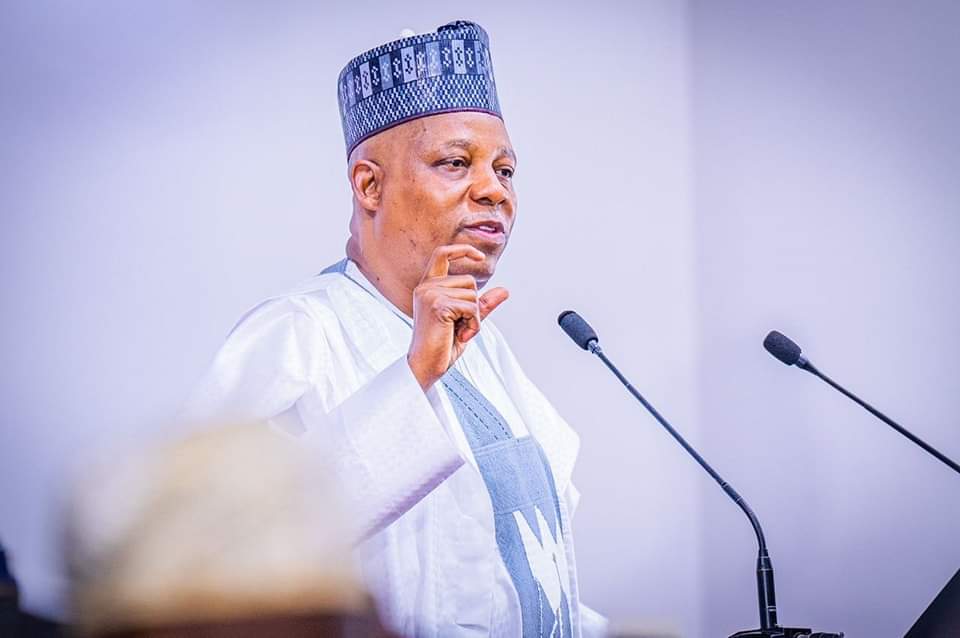
Vice President Kashim Shettima is back in Nigeria after leading the country’s delegation to the 81st United Nations General Assembly in New York, where Nigeria pressed for UN reforms, stronger African representation and greater support for developing countries. Shettima left Abuja on September 20 after President Bola Tinubu directed him to represent him and lead […]
Vice President Kashim Shettima is back in Nigeria after leading the country’s delegation to the 81st United Nations General Assembly in New York, where Nigeria pressed for UN reforms, stronger African representation and greater support for developing countries.
Shettima left Abuja on September 20 after President Bola Tinubu directed him to represent him and lead Nigeria’s delegation at the global gathering.
The Vice President subsequently delivered Nigeria’s national statement during the General Debate, presenting the country’s position on international issues with implications for development, peace, security and economic growth.
One of Nigeria’s major positions at the gathering was its renewed demand for permanent African representation on the UN Security Council.
The country also advocated fairer global financing arrangements, stronger climate support and deeper multilateral cooperation as part of its call for reforms to the international system.
Nigeria’s delegation also placed emphasis on Africa’s natural resources and the need for the continent to benefit more from its vast mineral wealth.
At the Africa Minerals Strategy Group’s high-level roundtable, Shettima urged African countries to move beyond the export of raw minerals and focus more on processing, manufacturing and value addition.
The Vice President also participated in a high-level education financing event organised by Nigeria and Italy, where he reiterated the Federal Government’s commitment to improving education.
Nigeria supported the Global Partnership for Education’s $5bn financing campaign, with Shettima describing education as an important investment in productivity, human capital and national prosperity.
The Vice President’s engagements also extended beyond the UN headquarters, including a meeting with Nigerians living abroad.
During the interaction, he highlighted the contributions that Nigerians in the Diaspora could make through investments, expertise and international networks.
Shettima also met with the leadership of the ECOWAS Commission and UN Deputy Secretary-General Amina Mohammed as part of efforts to strengthen regional and international cooperation.
The meetings addressed issues including development financing, regional integration, economic cooperation, technology, peace and security.
His participation at the UNGA was in line with the Tinubu administration’s broader diplomatic agenda, including advocacy for reforms to global institutions and stronger African participation in international decision-making.
Having completed the assignment, Shettima has returned to Nigeria after a week of high-level diplomatic engagements in New York, where Nigeria presented its priorities on the global stage.